Knowledge Base / Glossary
Convex hull
Every weighted average of a set of points whose weights are nonnegative and sum to one.
A convex combination of vectors \(v_1,\ldots,v_n\) is a weighted average
\[ \sum_{i=1}^{n} p_i v_i, \qquad p_i\ge 0, \qquad \sum_{i=1}^{n} p_i=1. \]The convex hull of those vectors is the set of all such combinations. For a finite set of points in a plane it is the filled convex polygon enclosed by a rubber band stretched around them, boundary included. If the points all lie on one line, the hull is a line segment, and a single point is its own hull. In higher dimension the hull is the corresponding convex solid, which can still be flat: three points in a space of any dimension span only a triangle.
For each token \(t\), let \(e_t\) be its input embedding, the vector the model looks up when it reads that token, and let \(p_t\) be the model’s next-token probability for it. A soft token is \(\sum_t p_t e_t\). Those weights are nonnegative and sum to 1, so the soft token lies in the convex hull \(K\) of the embeddings. That hull is closed and bounded, because it is the convex hull of finitely many points. The soft-token map feeds its input vector in the place where a token’s embedding would go, so any vector of the embedding space, and in particular any point of \(K\), is a valid input. It therefore sends every input into \(K\), and in particular it sends \(K\) into itself.
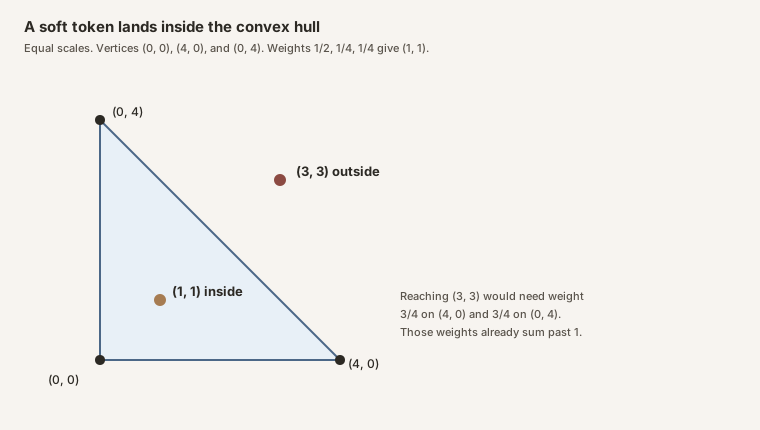
Scroll horizontally to inspect the diagram. The caption below provides a full text explanation.
Worked example
Let \(e_1=(0,0)\), \(e_2=(4,0)\), \(e_3=(0,4)\), and let the weights be \(1/2\), \(1/4\), \(1/4\). Then
\[ \frac12 e_1+\frac14 e_2+\frac14 e_3=(1,1), \]which lies inside the triangle. The point \((3,3)\) does not. Any weights that reproduce it would have to sum to 1 and stay nonnegative, and no such weights exist: the first coordinate would require weight \(3/4\) on \(e_2\), the second weight \(3/4\) on \(e_3\), and those two weights already sum to more than 1.
def convex_combination(points, weights):
    if len(points) == 0 or len(points) != len(weights):
        raise ValueError("points and weights must be nonempty and the same length")
    if any(weight < 0 for weight in weights):
        raise ValueError("weights must be nonnegative")
    if abs(sum(weights) - 1.0) > 1e-12:
        raise ValueError("weights must sum to one")
    width = len(points[0])
    if any(len(point) != width for point in points):
        raise ValueError("all points must have the same dimension")
    return [
        sum(weight * point[i] for weight, point in zip(weights, points))
        for i in range(width)
    ]
Membership in the convex hull is not a probability that a token is correct. The weights \(p_t\) are the model’s next-token probabilities; the combination they form is a vector, not a token.
See also: embedding, Brouwer’s fixed-point theorem.