Knowledge Base / Glossary
Logit
An unnormalized next-token score. Softmax turns a vector of logits into probabilities.
A logit, in these notes, is one unnormalized score for a vocabulary token, before that score is turned into a probability. The unembedding, the final layer that maps the model’s hidden state to one score per vocabulary token, produces a vector \(z\), with one logit \(z_v\) for each token \(v\) in the vocabulary \(V\). Softmax converts the vector into the next-token distribution, where \(p_v\) is the probability assigned to token \(v\) and \(\exp\) is the exponential function:
\[ p_v=\frac{\exp(z_v)}{\sum_{u\in V}\exp(z_u)}. \]A logit is not a probability. It can be negative, and it has no fixed range. Adding the same number to every logit leaves every probability unchanged, because that number cancels between the numerator and the denominator. The differences are log probability ratios:
\[ z_i-z_j=\log\frac{p_i}{p_j}. \]Here \(\log\) is the natural logarithm, the inverse of \(\exp\).
A greedy continuation emits a token whose logit is the largest; if several tokens tie, the implementation’s tie-breaking rule decides among them. Dividing every logit by a positive temperature keeps the order of the logits, ties included. It changes the probabilities unless the temperature is 1 or all the logits are equal.
This is not the binary log-odds function \(\operatorname{logit}(p)=\log\frac{p}{1-p}\), which sends one probability to one number. A language-model logit vector is the input to softmax over the whole vocabulary. When the choice is between exactly two tokens, the difference of their logits equals that log-odds.
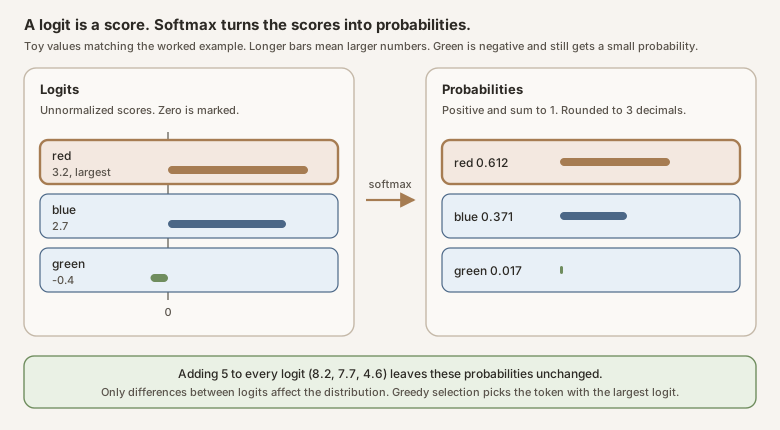
Scroll horizontally to inspect the diagram. The caption below provides a full text explanation.
Worked example
The same scores as on the greedy-continuation page:
| Token | Logit \(z\) | Probability, rounded to 3 decimals |
|---|---|---|
red |
3.2 | 0.612 |
blue |
2.7 | 0.371 |
green |
-0.4 | 0.017 |
The unrounded weights are \(\exp(z-\max z)\), then divided by their sum. green is negative and still has positive probability. red is the greedy token because \(3.2\) is the largest logit. The value \(0.612\) is the probability the model assigns to red; on its own it does not show that the model is calibrated, meaning that, across many predictions, tokens given probability near 0.612 turn out to be the actual next token about 61.2% of the time. Shifting every logit by \(+5\), to \(8.2\), \(7.7\), and \(4.6\), returns the same three probabilities. The log ratio of red to blue is \(3.2-2.7=0.5\).
from math import exp

def softmax(logits: list[float]) -> list[float]:
    """Turn unnormalized scores into probabilities that sum to one."""
    if len(logits) == 0:
        raise ValueError("logits must be nonempty")
    maximum = max(logits)  # Cancels in the ratio; keeps exp in range.
    weights = [exp(logit - maximum) for logit in logits]
    total = sum(weights)
    return [weight / total for weight in weights]
A logit lens is a separate procedure: it applies a specified readout, a mapping from a hidden state to one score per token, to the hidden state of an intermediate layer rather than the last one. Those scores are logits only under the readout the analyst specified. They are not automatically the model’s next-token logits.
See also: unembedding, temperature, sampling, greedy continuation, logit lens.