Knowledge Base / Glossary
Top-p
Nucleus sampling: keep only the smallest set of tokens whose cumulative probability reaches p, then sample within that set.
Top-p (also nucleus sampling) truncates the next-token distribution before sampling. Tokens are ordered by probability; you keep the smallest prefix whose cumulative mass is at least \(p\) (for example 0.9), zero out the rest, renormalize, and sample from what remains.
The token that crosses the boundary is included. For probabilities \([0.55, 0.25, 0.12, 0.08]\) and \(p=0.90\), the first two tokens total only 0.80, so the third is also retained: the nucleus has mass 0.92. After renormalization its probabilities are approximately \([0.598, 0.272, 0.130]\). Top-p does not mean “keep every token whose individual probability is at least \(p\),” and it does not discard the token that takes the cumulative sum past \(p\).
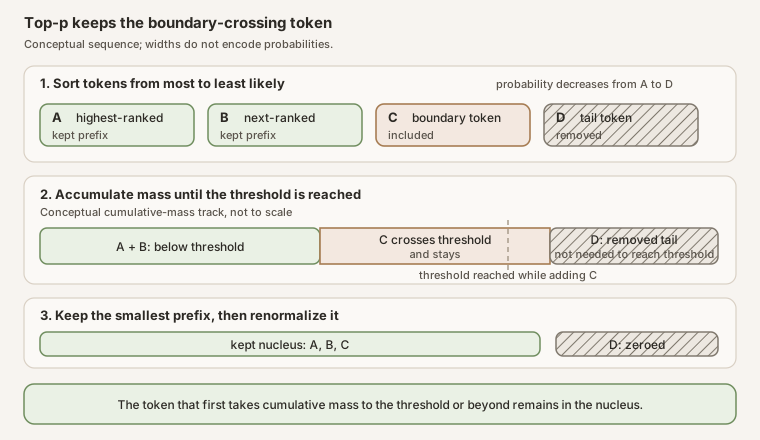
Scroll horizontally to inspect the diagram. The caption below provides a full text explanation.
def nucleus(tokens, probabilities, p):
    if not 0 < p <= 1:
        raise ValueError("top-p must be in (0, 1]")

    ranked = sorted(zip(tokens, probabilities),
                    key=lambda pair: pair[1], reverse=True)
    kept, mass = [], 0.0
    for token, probability in ranked:
        kept.append((token, probability))  # Include the boundary token.
        mass += probability
        if mass >= p:
            break
    return [(token, probability / mass) for token, probability in kept]
At very small positive \(p\), the nucleus contains at least the highest-probability token; at \(p=1\), it normally contains the full nonzero distribution. Exact ties, floating-point rounding, and library options such as a minimum number of retained tokens can affect the boundary, so record the implementation when it matters.
It is a different knob from temperature: temperature reshapes the whole distribution; top-p hard-cuts the long tail. They are often used together.
Like temperature, top-p does not change an ordinary greedy continuation when the maximum is unique. With tied maxima, applying top-p before argmax also requires compatible sorting and tie-breaking rules; an unfiltered greedy decoder simply ignores top-p.
See also: temperature, sampling, greedy continuation.