praxagent / Technical record
Research Notes
Experiments, methods, controls, and engineering notes from work on model internals and AI systems.
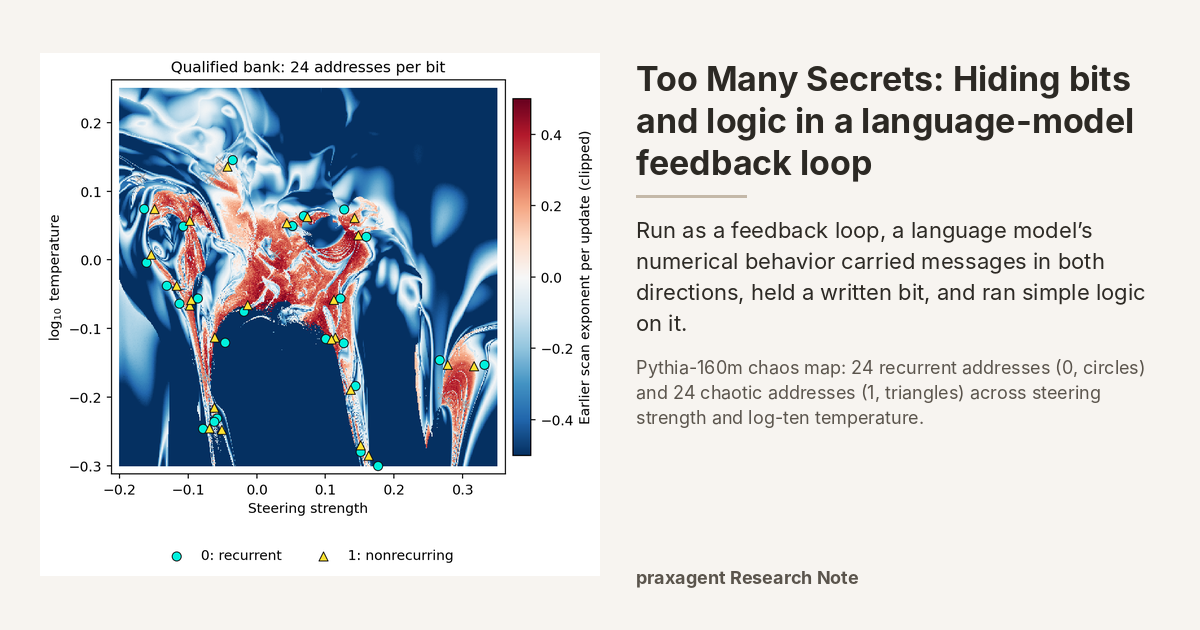
Too Many Secrets: Hiding bits and logic in a language-model feedback loop
Run as a feedback loop, a language model’s numerical behavior, rather than its words, carried complete requests and replies, held a written bit, and ran simple logic on it. A visual summary of what worked, what fell short, and why this is a channel rather than a secret.
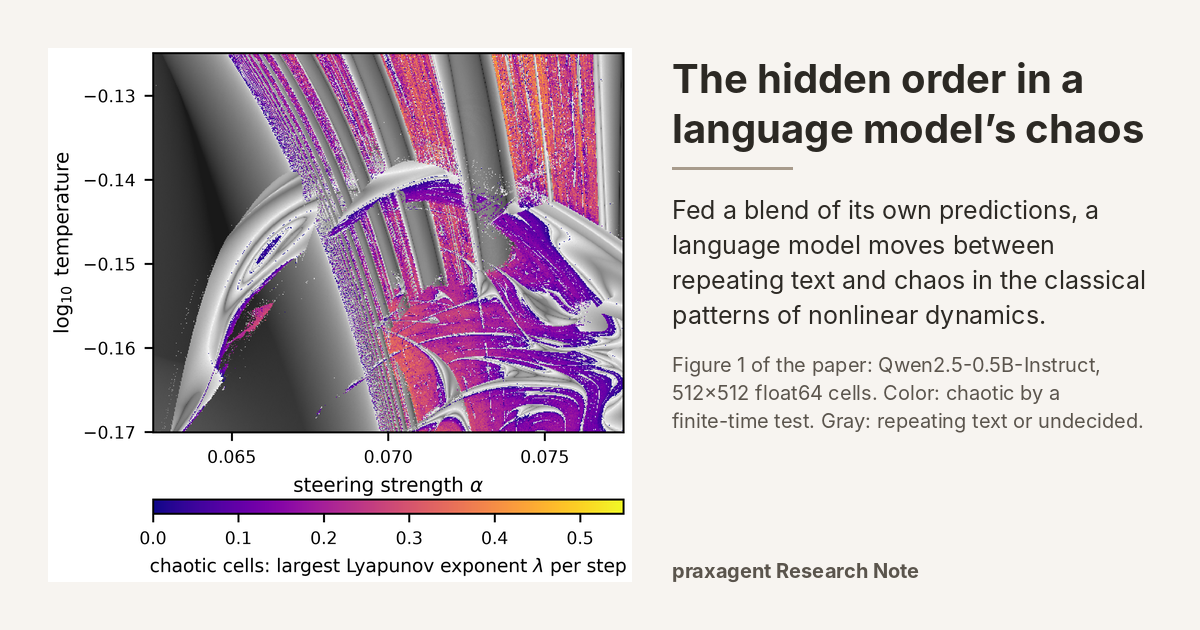
The hidden order in a language model’s chaos
Fed a blend of its own predictions, a language model moves between repeating text and chaos in the classical patterns of nonlinear dynamics. Its own derivatives predict parts of that structure, and computer proofs …
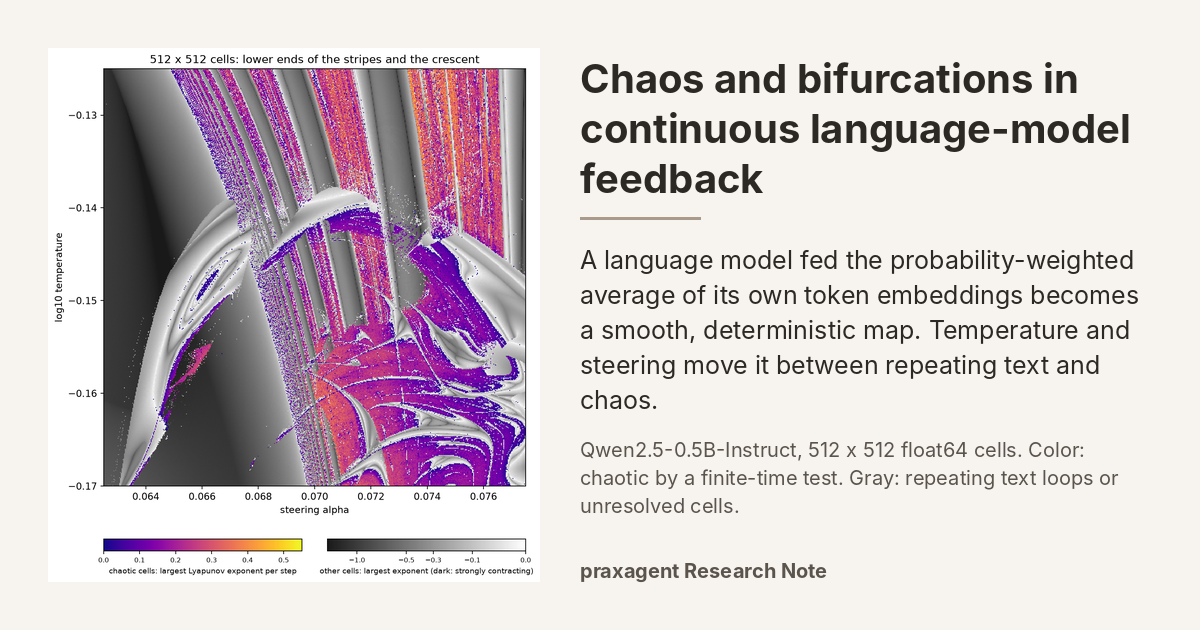
Chaos and Bifurcations in Continuous Language-Model Feedback
Feeding a language model the probability-weighted average of its own token embeddings, as a smooth full-distribution variant of Soft Thinking does, turns inference into a smooth deterministic map. In thirteen of fifteen …

A Linear Nudge, a Nonlinear Wake
We followed controlled hidden-state edits through the final 29 blocks of Llama 3.3 70B. The delivered edits scaled linearly with dose in all 24 test cells on the prespecified panel; the model's final hidden state did in …

Why Experimental Details Matter: Recovering from a Flawed Interpretability Study
A striking interpretability result was frozen in public git before it ran and still came from a flawed comparison. We trace how prompt echo, a domain-mismatched lexicon, and unequal stakes produced an overconfident …

Can a Jacobian Lens Detect SAE Steering?
A prospectively frozen Llama 3.3 70B experiment asks whether an auditor can tell, from a steered internal state alone, which public SAE feature was steered. Under a fixed Jacobian-lens readout the answer is no; the same …

Open-sourcing (and Auditing) a Jacobian Lens for Qwen3.5-397B
Praxagent is open-sourcing a Jacobian lens for Qwen3.5-397B-A17B, fitted on 24 WikiText prompts. As of July 10, 2026, to our knowledge no public Jacobian lens has been fitted for a larger base model. A pre-registered …

How to Read an SAE Feature ID
A primer on sparse autoencoders: what a feature ID is, how labels get assigned, and why an activation map is not yet an explanation. A public deception/roleplay feature set is used as a worked example under Llama 3.3 70B …