Knowledge Base / Glossary
Attention mask
A model or library rule that marks usable positions or specifies which sequence positions may exchange information.
An attention mask is a model or library rule that controls which sequence positions are usable or which positions may exchange information. The phrase is overloaded: it is used for at least two related but different objects.
- A one-dimensional valid-token mask marks real input positions and padding positions. For example, \([1,1,1,0]\) often means “use the first three positions and ignore the padded fourth position.”
- A two-dimensional pairwise attention mask says whether a position may attend to another position. In a causal language model, a position usually cannot attend to later positions.
The meaning of 0 and 1, the shape, and whether a library expects allowed positions or blocked positions are implementation conventions. Always check the model and library documentation.
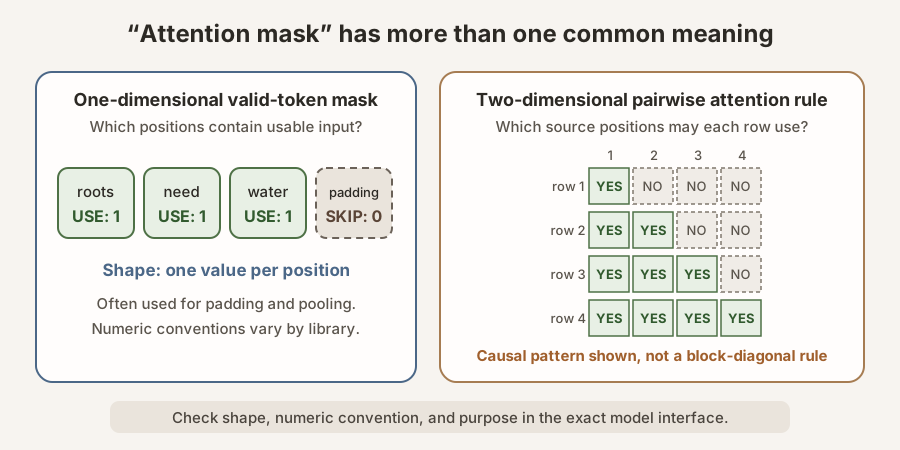
Scroll horizontally to inspect the diagram. The caption below provides a full text explanation.
A concrete four-position example
For tokens roots, need, water, and [PAD], a common valid-token mask is
Here \(m_i=1\) includes position \(i\), and \(m_i=0\) excludes it. The mask can keep the padding state out of mean pooling.
A causal pairwise mask for the three content positions can instead be written as
\[ A= \begin{bmatrix} 1 & 0 & 0 \\ 1 & 1 & 0 \\ 1 & 1 & 1 \end{bmatrix}. \]In this displayed convention, \(A_{ij}=1\) means position \(i\) may attend to position \(j\). The third position may use all three content positions, while the first may use only itself. Some software uses additive values such as 0 for allowed pairs and a large negative number for blocked pairs, so the matrix above is a concept, not a universal application programming interface.
Block boundaries are a separate choice
A mask is block-diagonal only when positions are divided into groups and cross-group attention is explicitly blocked. A normal padding mask does not create that pattern. When a long document is encoded with ordinary full attention, contextual token states may exchange information across later chunk boundaries. That cross-chunk context is central to late chunking.
What an attention mask does not establish
- A permitted attention link does not prove that the model used that link strongly.
- An attention weight is not automatically a causal explanation or a probability that text is true.
- Masking padding during attention does not automatically exclude padding from a later pooling operation.
- The name alone does not specify directionality, local windows, sparse patterns, or block boundaries.
See also: tokenization, mean pooling, Transformer.