Knowledge Base / Glossary
Tokenization
The model-specific process that divides an input into tokens and maps those tokens to integer identifiers.
Tokenization is the model-specific process that divides an input into units called tokens and maps each token to an integer token identifier. A token can be a word, part of a word, punctuation, whitespace attached to another piece, a byte, or a special control symbol. Tokens are not reliably the same as words.
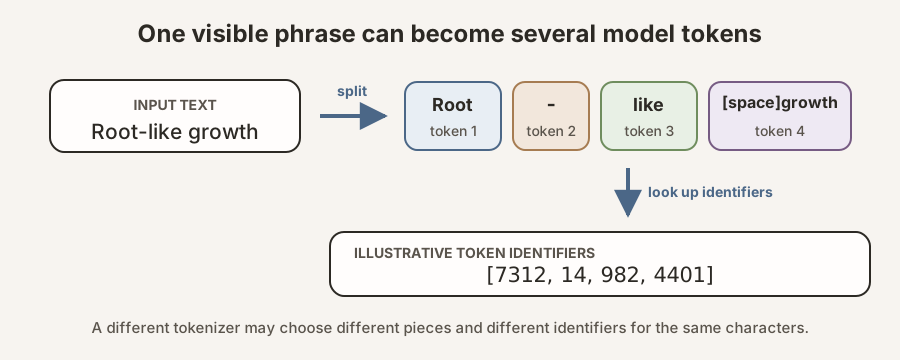
Scroll horizontally to inspect the diagram. The caption below provides a full text explanation.
Root-like growth into Root, -, like, and growth, then maps those pieces to integer identifiers. Another tokenizer could divide the same characters differently. The identifiers are arbitrary labels within one tokenizer vocabulary, not measurements or universal word codes.Why token boundaries matter
Suppose one tokenizer turns unbelievable into one token while another produces un, believ, and able. The second model uses three sequence positions for the same visible word. This changes token counts, where a fixed token limit cuts the text, and which token states are included by mean pooling.
For retrieval systems, a chunk is usually a span of the original text chosen by an application. A chunk is not automatically one token. The application may define a chunk in characters, words, sentences, or tokens, but it must eventually align the span with the tokenizer used by the encoder.
What a tokenizer usually returns
A practical tokenizer interface may provide:
- token identifiers for model input;
- special tokens required by the model;
- an attention mask that distinguishes usable positions from padding;
- offsets connecting token positions back to character spans in the original text.
Offsets are especially useful when a long document is encoded once and token states must later be assigned to smaller chunks. Special-token and whitespace conventions differ across libraries, so inspect the actual output rather than guessing from the displayed text.
A boundary check worth running
Before processing a full dataset, print the tokens, token identifiers, offsets, and reconstructed text for a few difficult inputs. Include punctuation, accented or non-Latin characters, long scientific names, and leading spaces. Also check the exact model revision because a different tokenizer or vocabulary can change every downstream boundary.
What tokenization does not establish
- A token is not necessarily a complete word, morpheme, or biological concept.
- Token identifiers have no useful numeric order. Identifier 500 is not “larger” in meaning than identifier 20.
- Decoding one token at a time may not reproduce the exact visible spacing of the full decoded sequence.
- Equal token counts across models do not imply equal information content.
See also: embedding, attention mask, mean pooling, Transformer.