Knowledge Base / Glossary
Feed-forward network (FFN)
A computation with no feedback cycle; in a Transformer, usually the shared position-wise sublayer that transforms each token state separately.
A feed-forward network (FFN) is a neural-network computation in which values move from inputs through a finite sequence, or another arrangement with no feedback cycle, to outputs. During one forward computation, a later value is not fed back into an earlier operation. A residual or skip connection can still be feed-forward when it only carries an earlier value to a later operation.
In Transformer writing, FFN usually means something narrower: the position-wise feed-forward sublayer inside each block. The same learned function transforms every token-position state separately. A multilayer perceptron (MLP) is a common implementation of that function.
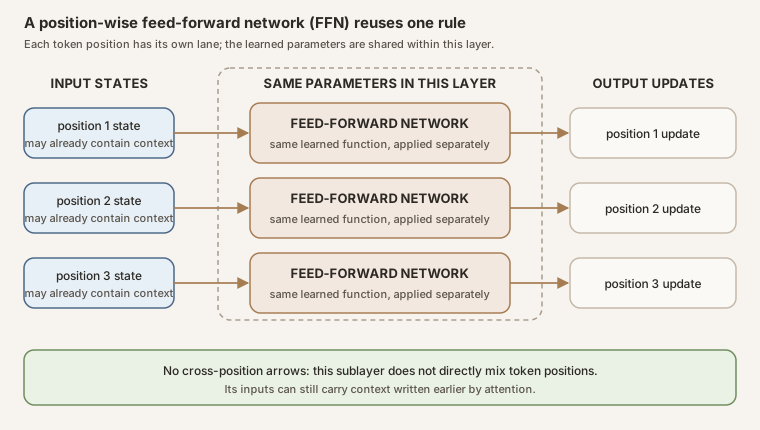
Scroll horizontally to inspect the diagram. The caption below provides a full text explanation.
Position-wise means one row at a time
Let \(\mathbb{R}\) denote the real numbers. Suppose \(H\in\mathbb{R}^{n\times d_{\text{model}}}\) contains one row for each of \(n\) token positions, with \(d_{\text{model}}\) coordinates per row. A position-wise FFN computes
\[ Y_{t,:}=f_\theta(H_{t,:}), \qquad t\in\{1,\ldots,n\}. \]Here \(t\) selects a token position, the colon means all coordinates in that row, \(f_\theta\) is the learned feed-forward function, and \(\theta\) denotes its learned numeric parameters. The same \(\theta\) is reused for every position within this layer. Different layers normally have different parameters.
The output row \(Y_{t,:}\) does not directly read a different input row \(H_{s,:}\) when \(s\ne t\). That does not make it context-free: \(H_{t,:}\) may already contain information gathered from other positions by attention. The original Transformer described this sublayer as two learned affine transformations with a rectified linear unit between them, applied to each position separately and identically (Vaswani et al., 2017, Section 3.3). Modern blocks may use gated variants instead (Shazeer, 2020).
FFN, position-wise FFN, and MLP
| Term | What it identifies |
|---|---|
| Feed-forward network | A forward computation with no feedback cycle |
| Position-wise FFN | The Transformer sublayer’s role: apply one learned function separately at each token position |
| Multilayer perceptron | A common layered implementation using learned affine maps and nonlinear activation or gating |
These labels often refer to the same module in Transformer code, but they emphasize different facts. Feed-forward describes connectivity, position-wise describes how token positions are handled, and MLP describes a common internal construction.
What feed-forward does not mean
- It does not mean that training only moves forward. Training can still work backward through the operations to determine how learned parameters should change.
- Fully connected means a learned map can combine coordinates within one token vector. It does not mean the FFN directly mixes token positions.
- Shared parameters across positions do not imply shared parameters across layers.
- The FFN’s output is an internal update to the residual stream, not a final token probability.
See also: multilayer perceptron (MLP), Transformer, residual stream.