Knowledge Base / Glossary
Jacobian lens
A corpus-averaged linear map that turns a mid-layer residual-stream state into vocabulary-ranked readout scores.
A Jacobian lens (J-lens) is a fixed linear transport built from derivatives of the network downstream of layer \(\ell\). If \(F_{\ell\rightarrow L}\) denotes the remaining computation, a prompt-specific local Jacobian describes how a small change propagates:
\[ \delta h_L \approx \frac{\partial F_{\ell\rightarrow L}}{\partial h_\ell}\, \delta h_\ell. \]A released J-lens averages such local Jacobians over a fitting corpus and over prescribed source/target positions, schematically
\[ J_\ell = \mathbb{E}_{(x,t,t')\sim\mathcal{C}} \left[ \frac{\partial h_{L,t'}}{\partial h_{\ell,t}} \right], \qquad t'\ge t. \]The average makes \(J_\ell\) reusable, but it also smooths over context dependence. It is not the exact local Jacobian for every new prompt. A strict local Taylor reconstruction would also include a context-dependent intercept and apply the Jacobian to a perturbation; the lens deliberately reuses only the averaged linear part as a context-general directional transport.
To inspect a residual or a direction \(v\), the transported vector is normalized and unembedded into vocabulary scores:
\[ z_\ell(v) = W_U\,N_f(J_\ell v) + b_U. \]The output bias \(b_U\) is optional. Omit it when the architecture has no bias or when the analysis explicitly defines a bias-free directional score; document that choice because it can affect absolute vocabulary ranks.
# Matrix orientation varies by implementation; shapes should be checked.
transported = J[layer] @ vector
scores = output_head(final_norm(transported))
probe_rank = rank_of(scores, probe_token_id)
This is best read as a verbalizability or vocabulary-alignment readout under the corpus-derived transport. It is not simply “what the model is about to say.” A highly ranked token can be absent from the eventual continuation, and an important internal computation need not align cleanly with any single token.
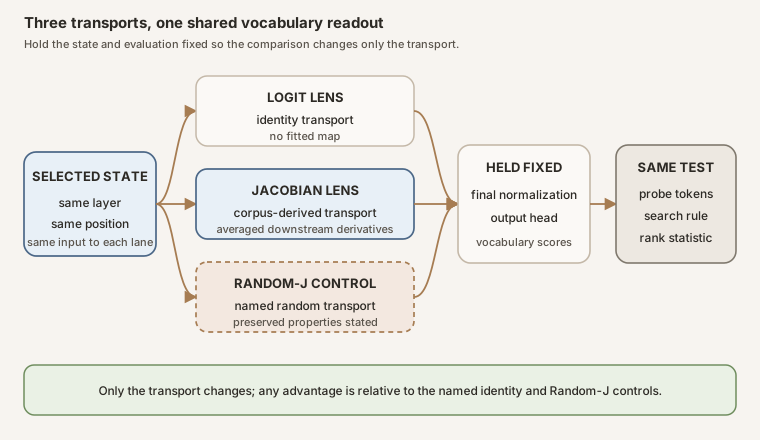
Scroll horizontally to inspect the diagram. The caption below provides a full text explanation.
Not the tuned lens
A tuned lens learns a per-layer affine translator directly to predict the model’s final output distribution. A Jacobian lens instead estimates its transport by averaging downstream derivatives, giving it a local perturbation interpretation before that averaging. Both use layerwise linear or affine transports before the model’s final normalization and unembedding, but one is optimized for output prediction while the other estimates average local propagation; they should not be treated as interchangeable.
It is not free. You download (or estimate) a published matrix file, hash it, and apply it per layer. The cheap baseline that skips the corpus-derived map is the logit lens.
Worked interpretation
For a hidden-bridge prompt, score the same absent bridge token at the same position and layers with the J-lens, the logit lens, and random-J. If only the corpus-derived transport gives the bridge a strong, repeatable rank, that supports a transport-specific readout of bridge-related vocabulary on those examples. It still does not prove that the model would say the bridge, that a single bridge variable exists, or that the measured state caused the final answer.
Use it when you care about intermediate directions whose downstream vocabulary alignment may be poorly expressed by the identity readout. Do not claim it was necessary if the logit lens already sees the same signal, and do not turn a probe result into a causal claim without an intervention.
See also: logit lens, residual stream, hidden bridge, workspace.