Knowledge Base / Glossary
RMS normalization
Rescaling a vector by a stabilized root mean square of its coordinates, then by a learned gain on each coordinate.
RMS normalization rescales a hidden vector, the list of \(d\) numbers a model carries for one token between its layers, by a stabilized root mean square of its coordinates, then multiplies each coordinate by its own learned gain. For \(h\in\mathbb{R}^d\) and a gain vector \(g\in\mathbb{R}^d\),
\[ r(h)=\sqrt{\frac{1}{d}\sum_{i=1}^{d} h_i^2}, \qquad y_i=g_i\,\frac{h_i}{\sqrt{r(h)^2+\varepsilon}}, \qquad i=1,\ldots,d. \]Here \(r(h)\) is the ordinary root mean square of the coordinates, and the small constant \(\varepsilon>0\) keeps the denominator at least \(\sqrt{\varepsilon}\), including at \(h=0\). The map is therefore smooth at the origin. Unlike a layer normalization, which also subtracts the mean of the coordinates, RMS normalization does not remove the mean, so shifting every coordinate by the same amount changes the result. The Qwen2.5 models studied in the note on chaos in a language model’s feedback loop use RMS normalization.
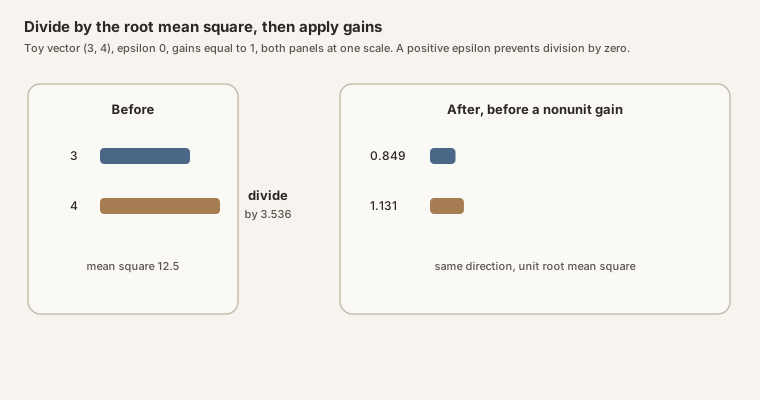
Scroll horizontally to inspect the diagram. The caption below provides a full text explanation.
Worked example
Take \(h=(3,4)\), \(d=2\), \(\varepsilon=0\), and \(g=(1,1)\). The mean of the squares is \((9+16)/2=12.5\), and
\[ r(h)=\sqrt{12.5}\approx 3.5355. \]The normalized coordinates are \(3/3.5355\approx 0.8485\) and \(4/3.5355\approx 1.1314\). For a small positive \(\varepsilon\) such as \(10^{-6}\) or \(10^{-5}\), they are unchanged to four decimal places. At \(h=(0,0)\), the denominator is \(\sqrt{\varepsilon}\) and \(y=0\).
def rms_normalize(values, gain, epsilon):
    if len(values) == 0 or len(values) != len(gain):
        raise ValueError("values and gain must be nonempty and the same length")
    if epsilon <= 0:
        raise ValueError("epsilon must be positive")
    mean_square = sum(value * value for value in values) / len(values)
    scale = (mean_square + epsilon) ** 0.5
    return [g * value / scale for g, value in zip(gain, values)]
The output is a hidden vector, not a vector of vocabulary scores. Those scores appear only after the unembedding.
See also: residual stream, unembedding.