Knowledge Base / Glossary
SiLU
The activation that multiplies a number by its own sigmoid, smooth through zero.
SiLU (sigmoid linear unit), also called swish, multiplies a number by the sigmoid of itself:
\[ \mathrm{SiLU}(x)=x\,\sigma(x)=\frac{x}{1+e^{-x}}. \]The sigmoid is smooth, and so is this product. In particular there is no corner at \(0\): \(\mathrm{SiLU}(0)=0\) and the slope there is \(1/2\). The dense models studied in the note on chaos in a language model’s feedback loop use SiLU inside a gated feed-forward block. That block computes two vectors from the same input, applies SiLU to one of them coordinate by coordinate, and multiplies the result, coordinate by coordinate, with the other.
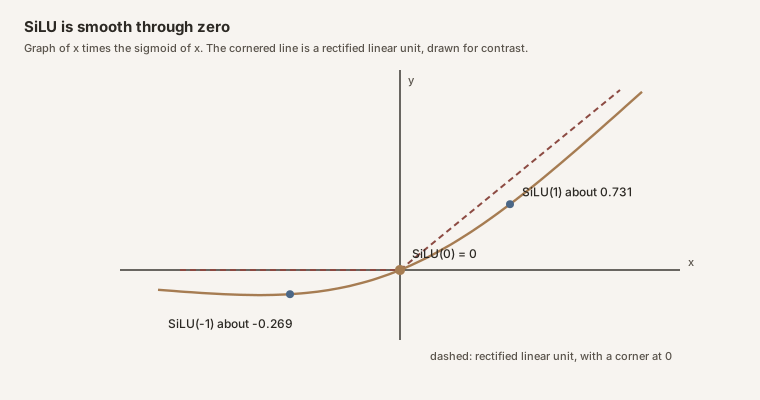
Scroll horizontally to inspect the diagram. The caption below provides a full text explanation.
Worked example
\[ \begin{aligned} \mathrm{SiLU}(0) &= 0,\\ \mathrm{SiLU}(1) &= \frac{1}{1+e^{-1}} \approx 0.7311,\\ \mathrm{SiLU}(-1) &= \frac{-1}{1+e^{1}} \approx -0.2689. \end{aligned} \]Negative inputs are not clipped to zero. They are shrunk toward zero, because the sigmoid of a large negative number is small. For such inputs the code below uses the equal form \(x\,e^{x}/(1+e^{x})\), because \(e^{-x}\) would overflow.
from math import exp

def silu(x: float) -> float:
    """Return SiLU for a finite scalar input."""
    if x >= 0.0:
        return x / (1.0 + exp(-x))
    ex = exp(x)
    return x * ex / (1.0 + ex)
SiLU is a scalar function applied coordinate by coordinate inside a block. It is not a next-token probability, and applying it does not by itself produce a vocabulary distribution.
See also: feed-forward network, multilayer perceptron (MLP).