Knowledge Base / Glossary
Cosine similarity
A comparison of two nonzero vectors based on the angle between them rather than their lengths.
Cosine similarity compares the directions of two nonzero vectors. It is the cosine of the angle between them: vectors pointing in the same direction score 1, perpendicular vectors score 0, and vectors pointing in opposite directions score (-1).
For nonzero vectors \(a,b\in\mathbb{R}^{d}\),
\[ \operatorname{cosine}(a,b) = \frac{a\cdot b}{\lVert a\rVert_2\lVert b\rVert_2} = \frac{\sum_{j=1}^{d}a_jb_j} {\sqrt{\sum_{j=1}^{d}a_j^2}\sqrt{\sum_{j=1}^{d}b_j^2}}. \]Here \(\mathbb{R}\) is the set of real numbers, \(d\) is the number of coordinates, \(j\) identifies one coordinate, \(a\cdot b\) is the dot product obtained by multiplying matching coordinates and summing them, and \(\lVert\cdot\rVert_2\) is Euclidean length.
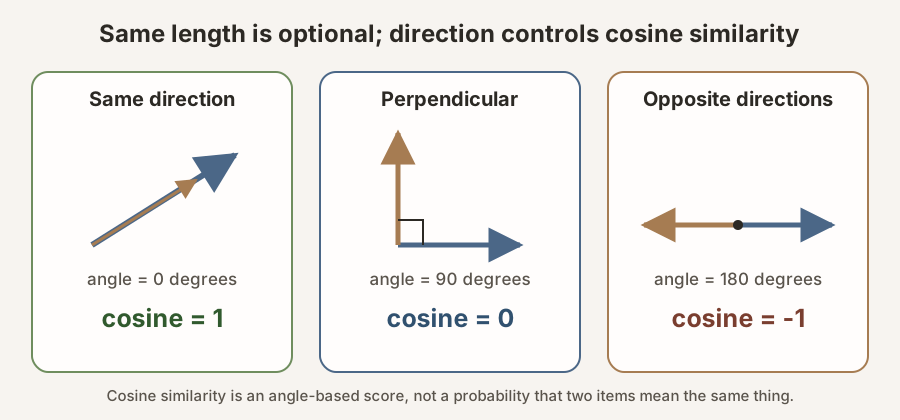
Scroll horizontally to inspect the diagram. The caption below provides a full text explanation.
Worked example
Let \(a=(1,0)\) and \(b=(1,1)\). Their dot product is 1, their lengths are 1 and \(\sqrt{2}\), and therefore
\[ \operatorname{cosine}(a,b) = \frac{1}{\sqrt{2}} \approx 0.707. \]If both inputs have already received L2 normalization, each has length 1 and cosine similarity reduces to their dot product.
import math

def cosine_similarity(a, b):
    if len(a) != len(b):
        raise ValueError("vectors must have the same dimension")
    length_a = math.sqrt(sum(x * x for x in a))
    length_b = math.sqrt(sum(y * y for y in b))
    if length_a == 0 or length_b == 0:
        raise ValueError("cosine similarity is undefined for a zero vector")
    return sum(x * y for x, y in zip(a, b)) / (length_a * length_b)

assert math.isclose(cosine_similarity((1, 0), (1, 1)), 1 / math.sqrt(2))
Similarity, distance, and ranking
Some systems define cosine distance as \(1-\operatorname{cosine}(a,b)\). Libraries can use other names or conventions, so record the exact function. A retrieval system can rank document embeddings by decreasing cosine similarity to a query embedding. Ranking quality then needs relevance judgments and retrieval metrics; a large similarity score alone is not an evaluation.
What cosine similarity does not establish
- It is not a probability, confidence level, or percentage match.
- A score near 1 does not prove factual agreement, biological equivalence, or causation.
- It is undefined when either vector is zero.
- Its meaning depends on the encoder, layer, pooling rule, and data distribution that produced the vectors.
See also: embedding, mean pooling, L2 normalization, retrieval ranking metrics.