Knowledge Base / Glossary
L2 normalization
Rescaling a nonzero vector to Euclidean length one while preserving its direction.
L2 normalization rescales a nonzero vector so its Euclidean length is 1 while preserving its direction. The name comes from the L2 norm, another name for Euclidean length.
For a vector \(x=(x_1,\ldots,x_d)\) with \(d\) coordinates, its L2 norm is
\[ \lVert x\rVert_2 = \sqrt{\sum_{j=1}^{d}x_j^2}. \]Here \(j\) identifies a coordinate and \(x_j\) is its value. If \(x\ne 0\), its L2-normalized vector is
\[ \hat{x}=\frac{x}{\lVert x\rVert_2}. \]The hat in \(\hat{x}\) labels the normalized version of \(x\).
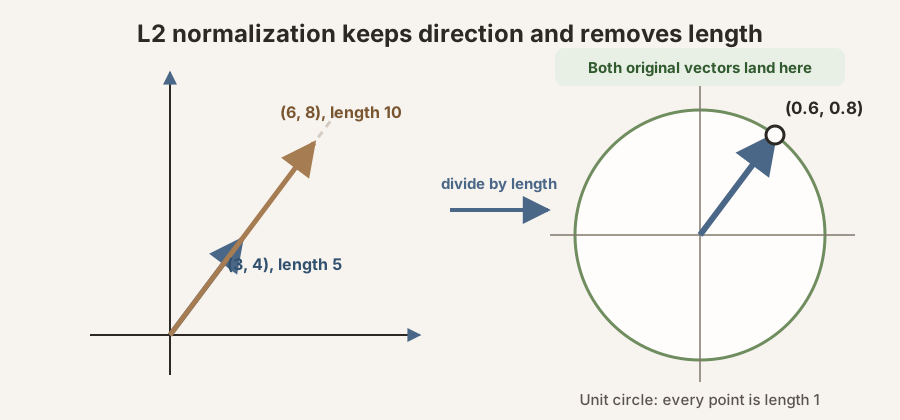
Scroll horizontally to inspect the diagram. The caption below provides a full text explanation.
Worked example
For \(x=(3,4)\),
\[ \lVert x\rVert_2=\sqrt{3^2+4^2}=5, \qquad \hat{x}=\left(\frac{3}{5},\frac{4}{5}\right)=(0.6,0.8). \]The normalized vector has length
\[ \sqrt{0.6^2+0.8^2}=1. \]import math
def l2_normalize(values):
length = math.sqrt(sum(value * value for value in values))
if length == 0:
raise ValueError("the zero vector has no direction to normalize")
return tuple(value / length for value in values)
assert l2_normalize((3.0, 4.0)) == (0.6, 0.8)
The zero-vector boundary
The zero vector has norm 0, so dividing it by its norm would divide by zero. A pipeline must choose an explicit behavior, such as raising an error, leaving the vector unchanged, or adding a small stabilizing constant. These choices are not mathematically identical. A zero pooled embedding may also signal an upstream masking or model problem worth investigating.
L2 normalization differs from root mean square (RMS) scaling. For \(d\) coordinates, \(\operatorname{RMS}(x)=\lVert x\rVert_2/\sqrt{d}\). A unit-L2 vector has RMS \(1/\sqrt{d}\), while a unit-RMS vector has L2 norm \(\sqrt{d}\).
Why retrieval systems use it
For nonzero vectors, the dot product of their L2-normalized versions equals their cosine similarity. Normalization therefore lets a vector database use a dot-product search while comparing directions. It also discards vector magnitude, which may be helpful or may remove meaningful information depending on how the encoder was trained.
What L2 normalization does not establish
- A unit-length vector is not a probability distribution; its coordinates can be negative and need not sum to 1.
- Equal directions do not prove equal text meaning or biological function.
- Normalization does not center features, standardize columns, or repair an inappropriate embedding model.
See also: embedding, mean pooling, cosine similarity, root mean square.