Knowledge Base / Glossary
Wilcoxon signed-rank test
A paired test that uses each gap's direction and its absolute-size rank, not just win counts.
The Wilcoxon signed-rank test (in these notes, the paired version) combines two pieces of each paired difference: its direction and the rank ordering of its absolute size. It does not use the raw magnitudes directly.
For a rank comparison, define
\[ D_i = \text{control rank}_i - \text{treatment rank}_i, \]so a positive value means the treatment achieved the better, lower vocabulary rank. Remove or otherwise handle zeros, rank the values \(\lvert D_i\rvert\) from smallest to largest, then restore each sign and add the positive and negative ranks.
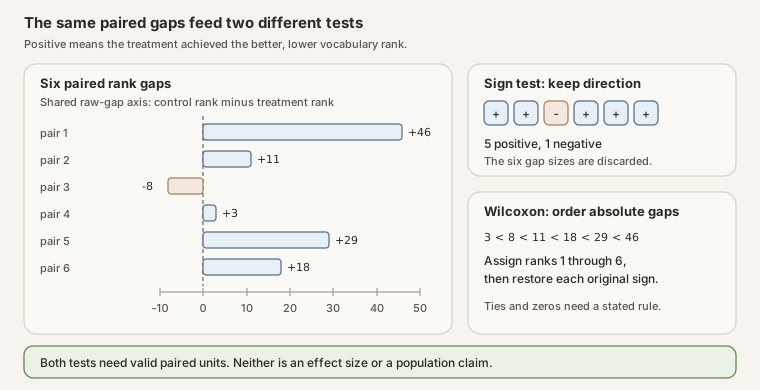
Scroll horizontally to inspect the diagram. The caption below provides a full text explanation.
Worked example
Use the six differences shown above:
| pair | \(D_i\) | \(\lvert D_i\rvert\) rank | signed rank |
|---|---|---|---|
| 1 | +46 | 6 | +6 |
| 2 | +11 | 3 | +3 |
| 3 | −8 | 2 | −2 |
| 4 | +3 | 1 | +1 |
| 5 | +29 | 5 | +5 |
| 6 | +18 | 4 | +4 |
The positive-rank sum is \(W^+=19\), the negative-rank sum is \(W^-=2\), and the usual two-sided statistic is the smaller value, \(W=2\). With six distinct nonzero absolute gaps, all \(2^6\) sign assignments can be enumerated exactly. Six are at least this extreme, so \(p=6/64=0.09375\).
Here is that final enumeration in standard-library Python:
from itertools import product

ranks = (6, 3, 2, 1, 5, 4)
observed = min(19, 2)
rank_total = sum(ranks)

null_statistics = []
for signs in product((False, True), repeat=len(ranks)):
    w_plus = sum(r for r, positive in zip(ranks, signs) if positive)
    null_statistics.append(min(w_plus, rank_total - w_plus))

p = sum(w <= observed for w in null_statistics) / len(null_statistics)
print(p)  # 0.09375
The example deliberately has no zeros or tied absolute gaps. Production analysis should use a tested statistics library and record its conventions.
Null and assumptions
- Null and sign flips: for the exact conditional signed-rank calculation, the joint distribution of the nonzero differences must be invariant under independently flipping any subset of their signs. Independent differences that are each symmetric around zero are a standard sufficient condition; conditional on the absolute gaps, each of the \(2^n\) sign assignments then has probability \(2^{-n}\).
- Across-pair dependence: mere permutation exchangeability is not enough. The paired differences must be independent, or the experimental randomization or dependence model must otherwise justify those coordinatewise sign flips. Several paraphrases descended from one template may not; see i.i.d..
- Ties and zeros: equal absolute gaps receive average ranks. A zero difference may be dropped, included only in ranking, or split according to the chosen procedure. Those choices change the null distribution and must be stated; many software packages cannot use their simplest “exact” calculation when zeros or ties occur.
- Sidedness: a two-sided test asks about either direction. A one-sided test is appropriate only for a direction fixed before seeing outcomes.
- Difference scale: vocabulary rank is ordinal and strongly skewed. Decide in advance whether \(D_i\) is a raw-rank gap, log-rank gap, or another score; a nonlinear transformation can change the ordering of absolute gaps.
How it differs from the sign test
The sign test asks only how many pairs win. Wilcoxon gives more weight to observations with larger absolute-gap ranks, which can improve sensitivity when its symmetry and scale assumptions are credible. That extra sensitivity is not free: the sign test is the simpler robustness check when only direction is trustworthy.
We often report both as within-battery consistency summaries. Neither is an effect size, a correction for trying many analyses, or evidence that the convenience battery represents a population. Report the direction count and actual rank gaps alongside either \(p\)-value. For unpaired binary counts in a \(2\times2\) table, use Fisher’s exact test instead of collapsing the pairs into a signed-rank analysis.
See also: p-value, Fisher’s exact test, i.i.d., rank, best-rank.