Knowledge Base / Glossary
BF16, FP16, and FP32
Floating-point formats for model arithmetic: 32-bit floating point (FP32), standard 16-bit floating point (FP16), and bfloat16 (BF16), and how their bit layouts trade range against precision.
Neural-network code stores numbers in floating-point formats: a sign bit, an exponent that largely controls range, and a significand that controls precision. The stored low-order portion is the fraction field, informally also called the mantissa. This page names three common data types (dtypes):
- FP32: 32-bit floating point (also called float32 or F32)
- FP16: 16-bit floating point (also called float16 or F16; IEEE 754 binary16)
- BF16: bfloat16 (brain floating point)
When these notes say BF16 activations, they mean intermediate tensors (multidimensional arrays) produced during a model’s forward computation that have BF16 storage dtype at the observation or write point.
| Name | Bits | Exponent bits | Trailing significand bits | Typical role |
|---|---|---|---|---|
| FP32 | 32 | 8 | 23 | Reference / high-precision math |
| FP16 | 16 | 5 | 10 | Mixed precision; narrower range |
| BF16 | 16 | 8 | 7 | Activations / matmuls; FP32-like range, less precision |
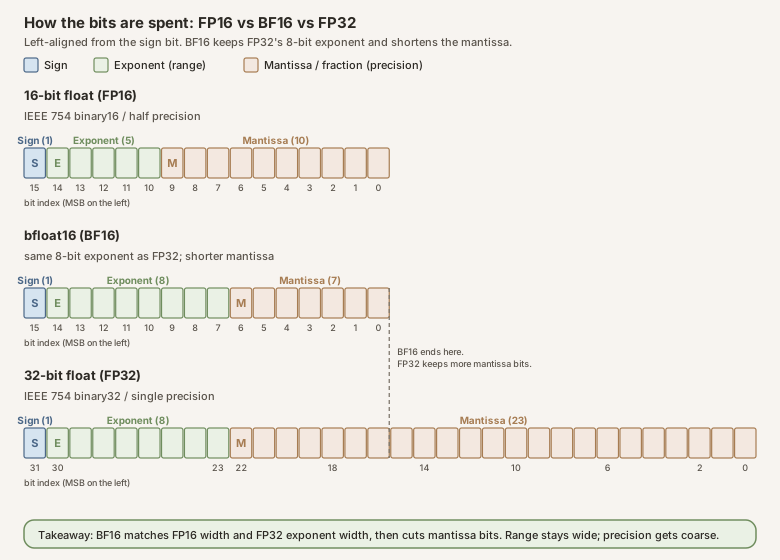
Scroll horizontally to inspect the diagram. The caption below provides a full text explanation.
BF16 is not “FP16 with a different name.” Same width as FP16; same exponent width as FP32; much shorter mantissa. Tiny increments can be lost when added to larger BF16 values (swamping).
For GPU Tensor Core support, PyTorch cast demos, the accumulation-swamping chart, overflow examples, and cuBLAS determinism notes, see the Deep Dive BF16, FP16, and FP32: Precision, Range, Swamping, and Determinism.
See also: matmul, root mean square (RMS), residual stream.