Knowledge Base / Glossary
Gini impurity
A measure of how mixed the class labels are inside a group of rows, used by decision trees to choose which feature cutoff to ask next.
Gini impurity scores how mixed the labels are inside a group of training rows. A group that is all one class scores 0. For a binary label, an even split scores the maximum, 0.5. Classification trees configured to use the Gini criterion choose each cutoff by that score: among the allowed questions, keep the one that lowers impurity the most.
The binary definition
Take a group of \(n\) rows, of which a fraction \(q\) are labeled positive. Binary Gini impurity is
\[ G=1-q^{2}-(1-q)^{2}=2q(1-q). \]It is 0 at \(q=0\) and at \(q=1\), and it peaks at \(0.5\) when \(q=0.5\). The middle form makes the idea plain. Draw two rows independently from the group, with replacement: \(q^{2}\) is the probability that both are positive and \((1-q)^{2}\) is the probability that both are negative, so \(G\) is the probability that their labels disagree. The drawing must be with replacement for those squares to be exact; sampling two distinct rows without replacement gives a slightly different disagreement probability. The same \(q(1-q)\) shape appears as the uncertainty term inside Brier loss, for the same reason: both measure how unsettled a binary outcome is before anything else is known.
With more than two classes the definition is \(G=1-\sum_{c}q_{c}^{2}\), where \(q_{c}\) is the fraction of the group in class \(c\). The binary formula above is that sum written out for two classes. The maximum depends on how many classes there are: with \(K\) classes present in equal proportion, \(G=1-1/K\), so the ceiling of 0.5 quoted above is the binary case.
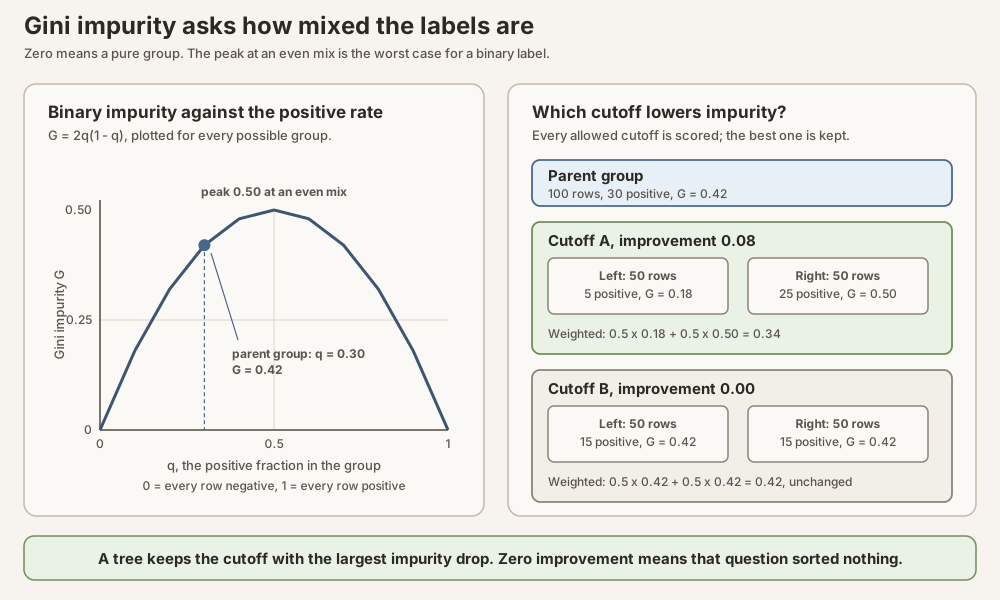
Scroll horizontally to inspect the diagram. The caption below provides a full text explanation.
Choosing a cutoff
A tree does not report the impurity of a leaf as a quality score for the finished model. It uses impurity only while growing. At a node, every allowed cutoff on every offered feature is scored by the impurity decrease
\[ \Delta G=G_{\mathrm{parent}} -\left(\frac{n_{L}}{n}G_{L}+\frac{n_{R}}{n}G_{R}\right), \]where \(n_{L}\) and \(n_{R}\) are the row counts in the left and right children. The tree keeps the cutoff with the largest \(\Delta G\). An improvement of zero means the question sorted nothing on these training rows.
The figure’s parent has \(q=0.30\) and \(G=0.42\). Cutoff A makes children with impurities 0.18 and 0.50; the weighted average is 0.34, so \(\Delta G=0.08\). Cutoff B makes two children identical to the parent, so \(\Delta G=0\).
def gini(positive_fraction: float) -> float:
    q = positive_fraction
    return 2.0 * q * (1.0 - q)

assert abs(gini(0.30) - 0.42) < 1e-12
assert abs(gini(0.10) - 0.18) < 1e-12
assert abs(0.5 * gini(0.10) + 0.5 * gini(0.50) - 0.34) < 1e-12
scikit-learn’s DecisionTreeClassifier and RandomForestClassifier use Gini
impurity when criterion="gini", which is the default. Both accept multiclass
targets, where the criterion is the general \(1-\sum_{c}q_{c}^{2}\); a binary
target is the case that reduces to the \(2q(1-q)\) form above
(documentation).
Entropy is the common alternative
The other standard split rule replaces Gini with binary entropy, \(H(q)=-q\log_{2}q-(1-q)\log_{2}(1-q)\), using the usual convention \(0\log_{2}0=0\) so that a pure group scores 0 rather than being undefined. The tree then keeps the cutoff that most reduces that quantity (information gain). Entropy also bottoms at a pure group and peaks at an even mix, but it rises more sharply near the middle. The two criteria can select different splits. Treat the criterion as a fitting choice and judge the finished model on held-out data, rather than reading the choice itself as evidence that one forest is better.
What Gini impurity does not establish
- It is a training-time split rule, not a held-out performance metric. A tree can drive every leaf impurity to zero and still fail on new rows.
- A leaf’s impurity is not the same object as the probability the leaf reports. The probability is the positive fraction \(q\) itself; impurity is \(2q(1-q)\).
- A feature that never wins a split on one path can still win elsewhere, so a zero improvement at one node is not a global irrelevance claim.
- Gini is not a proper scoring rule for the finished model’s probabilities. Grade those with Brier loss or log loss.
See also: Brier loss, bootstrap, and the Deep Dive Logistic Regression and Random Forest, where Gini chooses every split inside the fitted forest.