Knowledge Base / Glossary
Imputation
A documented rule for filling missing values so an analysis can use a complete table without pretending the missing measurements were recovered.
Imputation fills a missing cell with a value produced by a stated rule. For example, median imputation replaces a missing value with the median of the observed values in the same feature column.
A missing value may appear as a blank, NA, or NaN, which means “not a
number” in many data tools. Missing is not the same as zero. Imputation makes a
table complete enough for a method that cannot accept missing cells, but it
does not recover the measurement that was never observed.
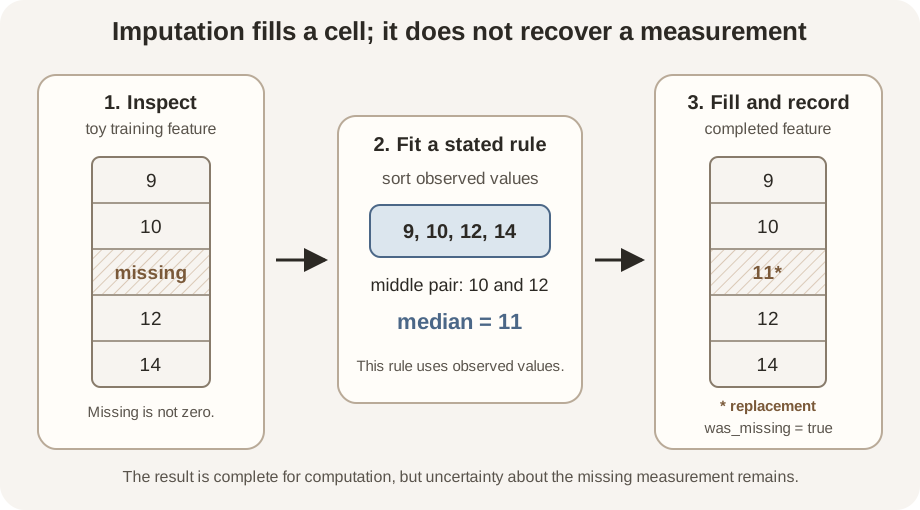
Scroll horizontally to inspect the diagram. The caption below provides a full text explanation.
A checkable median example
The median of \(9,10,12,14\) is halfway between the two middle values, so it is \(11\). This dependency-free Python applies that rule to a toy training column:
from statistics import median

lengths = [9.0, 10.0, None, 12.0, 14.0]
observed = [value for value in lengths if value is not None]
replacement = median(observed)
filled = [replacement if value is None else value for value in lengths]

assert replacement == 11.0
assert filled == [9.0, 10.0, 11.0, 12.0, 14.0]
The code is easy. The scientific decision is harder: whether 11 is a defensible replacement depends on why the value is missing and how the result will be used.
Investigate before filling
Ask these questions before choosing an imputation rule:
- Which features and biological or technical groups contain missing cells?
- Was the value lost randomly, or could absence reflect detection limits, sample quality, treatment, instrument, or operator?
- Does a single median make sense for every group and batch?
- How much of the table would be replaced?
- Does the interpretation survive another defensible missing-data treatment?
Deleting incomplete rows is also a missing-data decision. It can bias a result when the incomplete rows differ systematically from the retained rows.
What single imputation changes
Replacing several cells with the same median often reduces a feature’s variance and can alter correlations with other features. A downstream method treats the replacements as ordinary numbers unless the analysis explicitly represents their uncertainty. Multiple imputation is a broader approach that creates several plausible completed datasets, but it also requires assumptions and a rule for combining results.
For held-out prediction, fit the imputation rule on training rows only. Using the test rows to choose a median creates data leakage. In a purely descriptive full-dataset analysis, using all rows can match the stated goal, but the replacement and its effect must still be reported.
What imputation does not establish
- It does not prove what the missing value would have been.
- It does not make systematic missingness harmless.
- It does not correct a unit error, impossible value, duplicate row, or wrong label.
- It does not remove the need for a sensitivity analysis or uncertainty statement.
See also: data leakage, standard scaling, and principal component analysis.